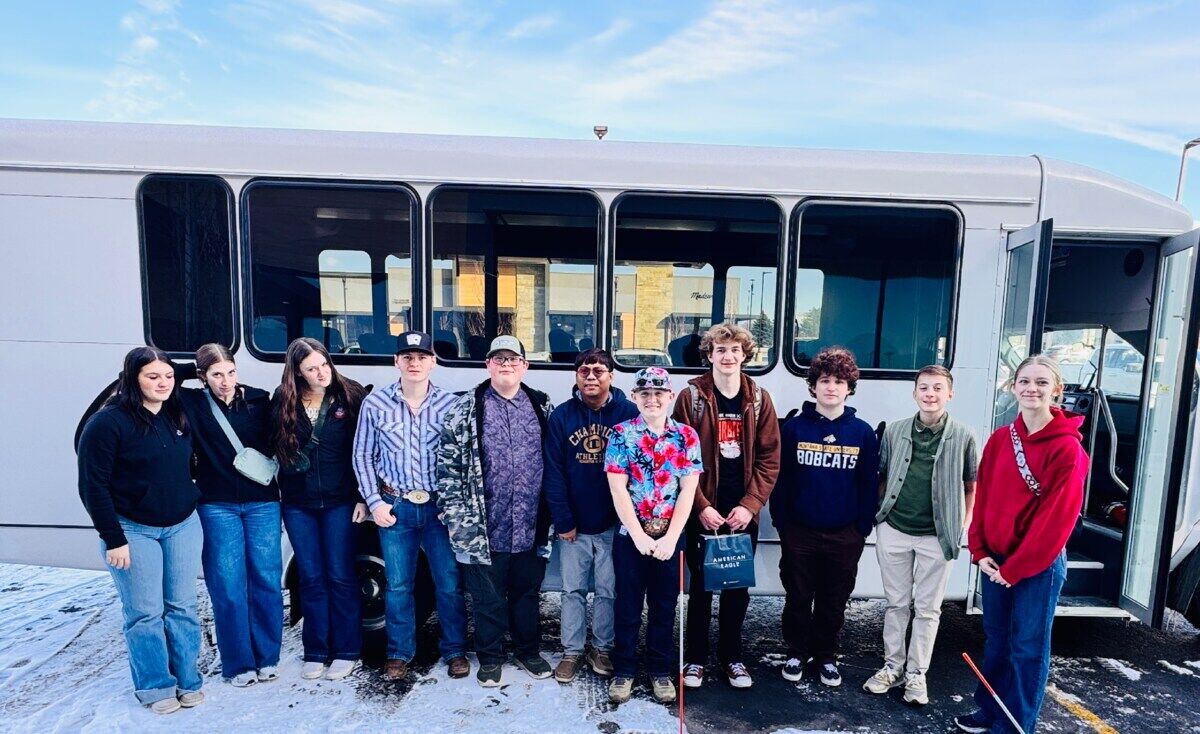
Just after noon on Wednesday, February 18, Chinook High School's Science Olympiad team departed for Bozeman. Hosted annually by the Montana State University (MSU) Science Math Resource Center, Montana's state tournament took place on February 19 on the campus of MSU–Bozeman. Seventy-eight teams competed on Thursday, representing fifty-seven Class B and C schools from across the state.
After all the data had been calculated and chemical aromas dissipated, winners were announced in Division C, the High School and Small Schools Division. Choteau High School came away on top, Ennis High School took second, and Roundup High School followed in third place. For their science mindedness, Chinook emerged in 20th place out of the 30 teams competing in this division.
"For many of these students, this event represents months of preparation, teamwork, and learning beyond the regular classroom," stated Mr. Michael Vinluan, Chinook High School's (CHS) Science Olympiad Advisor.
CHS students attending competed in Water Quality, Anatomy and Physiology, Astronomy, Rocks and Minerals, Experimental Design, and Bungee Drop. These events were divided into broader categories.
Under the broader umbrella of Life, Personal & Social Science, Chinook fielded competitors in two events. In Water Quality, participants Cynnloch Gibson and Wacee Simenson were assessed on their understanding and evaluation of freshwater aquatic environments. Among their tasks and tests, the pair had to apply ecological principles to aquatic food chains and food webs, assess population dynamics and community interactions, as well as address watershed resource management issues.
For all of Gibson's and Simenson's effort and preparation, Chinook captured 19th. About their participation, Gibson stated: "Water Quality helped me see how chemistry connects to real environmental problems. Even though the test was difficult, it showed me what topics I need to review more if I compete again. Next year, I want to be better prepared and more confident with data interpretation."
Meanwhile, the Anatomy & Physiology event assessed participants on their understanding of the two disciplines as they pertain to the nervous, special senses, and endocrine systems of the human body. With competitors Kamry Gustitis and Amyerah Kelly, Chinook ranked 21st out of 30 teams in this competition arena.
"This was my first time competing in the Science Olympiad, and I joined the event as a last-minute replacement. Even though it was a little overwhelming at first, the experience helped me learn how to stay focused under pressure. It gave me a better idea of what the Science Olympiad is like and encouraged me to prepare earlier if I have the chance to compete again," Gustitis stated.
Kelly agreed, saying: "Being a first-time competitor and stepping in at the last minute was challenging but rewarding. The Anatomy and Physiology event showed me what I need to work on and how important preparation is at the state level. I'm proud that I was able to represent our school and would like to be more involved in Science Olympiad in the future."
Likewise, two groups participated in events in the Earth & Space Science category: Astronomy and Rocks and Minerals. The Astronomy event invited members to demonstrate an understanding of stellar evolution from formation to destruction. Beyond testing general knowledge, this event further involved an understanding of such topics as the Hubble Space Telescope, exoplanets, and space photography. Shaune Baird captured 16th for CHS in Astronomy.
After his competition, Baird commented: "Astronomy was challenging but really interesting. It made me realize how much content there is beyond what we learn in class. This experience motivated me to study more astronomy topics on my own and to consider doing the event again next year with more preparation."
With the Rocks & Minerals event, Cassidy Darlington and Paige Murray landed 22nd place. The duo not only identified and classified rocks and minerals but also demonstrated knowledge of how rocks and minerals contribute to an understanding of geologic processes, aid in the interpretation of Earth's history and the development of natural resources, and are used by society.
Other members competed in the Inquiry & Nature of Science category. Under that umbrella, Experimental Design determined the participant's ability to design, conduct, and report the findings of an experiment performed entirely on-site. For their work, Cynnloch Gibson, Sidney Bowles, and Carter Rayburn scored 12th. This was Chinook's highest scoring team.
On their experience, Gibson shared his assessment: "Experimental Design taught me how important teamwork and clear thinking are under pressure. Designing quickly wasn't easy, but it helped me improve my problem-solving skills."
Bowles added: "I liked Experimental Design because it made us think creatively instead of just memorizing facts. Working with my teammates helped me learn how to communicate ideas better. This event made me more interested in doing hands-on science in the future."
Rayburn concluded: "As a senior, Experimental Design felt like a good way to end my Science Olympiad experience. The event challenged me to think critically and work efficiently with my teammates under pressure. It helped me reflect on how much my problem-solving and data analysis skills have grown, and I plan to carry these skills with me as I move on to the next stage of my education."
Close behind that trio's performance, Carter Alisch and Ezekiel Sanders snagged lucky number 13 in the Bungee Drop event. The team had to design one elastic cord to conduct drops at a given height(s) and attempt to move a weighted bottle as close as possible to, but without touching, a landing surface.
"Bungee Drop showed me how physics concepts actually work in real life. Seeing how small changes affected our results helped me understand engineering better. I want to improve our design skills if I do this event again," said Alisch.
His teammate, Sanders likewise determined: "Building, testing, and improving our design showed me how engineering is about learning from mistakes and making adjustments. This experience reinforced the importance of teamwork and persistence, lessons that I know will be valuable beyond high school."
In his second year coaching Science Olympiad, Vinluan claims that both the team and he are still learning and growing. "While STEM is not yet a flagship program at Chinook, our students continue to rise to the challenge and compete alongside much larger schools with long-established science programs. Finishing mid-pack in several events is a strong indicator of their capability, perseverance, and potential. These results affirm that Chinook students are bright, resilient, and capable of excelling in STEM when given opportunities and support."